2026 Honda CB650R vs 2026 Suzuki GSX-8S - Spec Comparison
Choose up to 4 bikes to compare
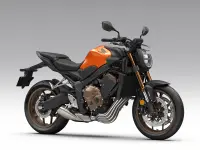
2026 Honda CB650R
The 2026 Honda CB650R is a naked bike powered by a 649cc in-line four with 94 hp and 63 Nm. It weighs 207 kg ready to ride, has an 810 mm seat and a 15.5-litre tank, and is available with Honda's E-Clutch.
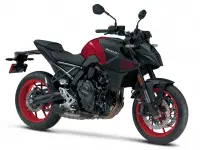
2026 Suzuki GSX-8S
The 2026 Suzuki GSX-8S is a naked bike with a 776cc parallel twin making 82 hp and 78 Nm. It weighs 202 kg ready to ride, has an 810 mm seat and a 14-litre tank, with Suzuki's ride-mode electronics.
2026 Honda CB650R vs 2026 Suzuki GSX-8S: the key differences
Both are naked bikes, so this is a like-for-like choice.
- The 2026 Honda CB650R makes 12.1 hp more (93.9 vs 81.8 hp).
- The 2026 Suzuki GSX-8S has 15 Nm more torque (63 vs 78 Nm).
2026 Honda CB650R: Designed primarily for spirited street riding and weekend canyon carving with an inline-four engine that loves to rev.
2026 Suzuki GSX-8S: Built primarily as a versatile everyday and weekend-fun naked bike that mixes commuting comfort with genuine cornering enthusiasm.
Verdict: Choose the 2026 Honda CB650R if you want more power. Choose the 2026 Suzuki GSX-8S if you want more torque. Check the full table below for every figure, and the size comparison for fit.
How they ride
Editorial estimate from the spec sheet - not lab tested. Further out = stronger on that axis.
| 2026 Honda CB650R | 2026 Suzuki GSX-8S | |
|---|---|---|
| Speed | 68 | 62 |
| Agility | 82 | 80 |
| Comfort | 62 | 65 |
| Off-road | 15 | 15 |
| Touring | 45 | 50 |
| Road manners | 85 | 84 |
| Specification | 2026 Honda CB650R | 2026 Suzuki GSX-8S |
|---|---|---|
| Other | ||
| Category | Naked | Naked |
| Color Options | Matte Black Metallic | Glass Sparkle Black/Pearl Cosmic Blue ), Metallic Matte Black |
| Comments | - | Suzuki Intelligent Ride System. |
| Engine | ||
| Capacity: | 649.0 ccm (39.60 cubic inches) | 776.0 ccm (47.35 cubic inches) |
| Engine Type | In-line four, four-stroke | Parallel Twin, four-stroke |
| Bore x Stroke | 67.0 x 46.0 mm (2.6 x 1.8 inches) | 84.0 x 70.0 mm (3.3 x 2.8 inches) |
| Compression | 11.6:1 | 12.8:1 |
| Cooling System | Liquid | Liquid |
| Fuel System | Injection | Injection |
| Starting | Electric | Electric |
| Ignition | Full transistorized | Electronic |
| Valves Per Cylinder | 4 | 4 |
| Fuel Consumption | - | 3.50 litres/100 km (28.6 km/l or 67.20 mpg) |
| Lubrication System | - | Forced feed circulation, wet sump |
| Performance | ||
| Power | ✓93.9 HP (70.0 kW) | 81.8 HP (60.2 kW) |
| Torque | 63.0 Nm (6.4 kgf-m or 46.5 ft.lbs) @ 9500 RPM | ✓78.0 Nm (8.0 kgf-m or 57.5 ft.lbs) |
| Power/Weight Ratio | 0.4541 HP/kg (wet) | 0.4050 HP/kg (wet) |
| 0-60 mph | 3.80 seconds | 3.40 seconds |
| 0-100 km/h (0-62 mph) | 4.10 seconds | 3.80 seconds |
| Chassis & suspension | ||
| Frame | Steel diamond | Steel |
| Front Suspension | 41mm inverted Showa Separate Function Fork Big Piston (SFF-BP); 4.7-inch travel | Inverted telescopic, coil spring, oil damped |
| Rear Suspension | Showa single shock w/ adjustable preload; 5.1-inch travel | Link type, coil spring, oil damped |
| Front Wheel Travel | 108 mm (4.3 inches) | 130 mm (5.1 inches) |
| Rear Wheel Travel | 128 mm (5.0 inches) | 130 mm (5.1 inches) |
| Rake (fork angle) | 25.5° | 25.0° |
| Trail | 101 mm (4.0 inches) | 104 mm (4.1 inches) |
| Ground Clearance | 147 mm (5.8 inches) | 145 mm (5.7 inches) |
| Transmission | ||
| Gearbox | 6-speed | 6-speed |
| Transmission Type | Manual | Manual |
| Final Drive | Chain | Chain |
| Clutch | Wet, multiplate with coil springs | Wet, multi-plate |
| Brakes & wheels | ||
| Front Brakes | Dual four-piston, radial-mount Nissin hydraulic calipers w/ 310mm floating discs; ABS | Double disc. ABS. Nissin, radial-mount 4-piston calipers |
| Front Brakes Diameter | 310 mm (12.2 inches) | - |
| Rear Brakes | Single one-piston hydraulic caliper w/ 240mm disc; ABS | Single disc. ABS. Nissin, 1-piston caliper |
| Rear Brakes Diameter | 240 mm (9.4 inches) | - |
| ABS | Yes | Yes |
| Front Tyre | 120/70-17 | 120/70-ZR17 |
| Rear Tyre | 180/55-17 | 180/55-ZR17 |
| Dimensions & weight | ||
| Wheelbase | 1448 mm (57.0 inches) | 1465 mm (57.7 inches) |
| Overall Length | 2129 mm (83.8 inches) | 2115 mm (83.3 inches) |
| Overall Width | 785 mm (30.9 inches) | 775 mm (30.5 inches) |
| Overall Height | 1074 mm (42.3 inches) | 1105 mm (43.5 inches) |
| Seat Height | ✓810 mm (31.9 inches) | ✓810 mm (31.9 inches) |
| Wet Weight | 206.8 kg (455.9 pounds) | ✓202.0 kg (445.3 pounds) |
| Fuel Capacity | ✓15.50 litres (4.09 US gallons) | 14.00 litres (3.70 US gallons) |
| Maintenance | ||
| Oil capacity | 2.70 litres (2.85 US quarts) | 3.90 litres (4.12 US quarts) |
| Reliability & safety | ||
| Bike Reliability ⓘ | 76 / 100 (good) All years of this model |
✓79 / 100 (good) All years of this model |
| Passed roadworthiness test first time | 89.3% (7,169 tests) | 91.2% (182 tests) |
| Safety recalls | 0 | 0 |
"Best" (✓) reflects that single spec only, not overall suitability - a bike can win on paper and still be the wrong choice for you. Ties are all marked; specs with no clear better/worse direction (e.g. displacement, wheel size) are never marked, only tinted where bikes differ.
Affiliate links - we may earn a commission from qualifying eBay purchases made through these links.
About this comparison tool
This tool puts up to four motorcycles side by side across their full specification sheets, drawn from a database of 46,000+ models and 1.73M+ individual specifications. Wherever a spec has a clear "better" direction - more power, less weight - the strongest figure in that row is highlighted automatically.
How to use it
Pick a make, model and year for each bike; the model and year lists update to match what you've selected. Two bikes are enough - use "Add another bike" for a third or fourth. Comparisons work across model years too, so you can compare a bike against its own earlier generation. Once you're happy with the lineup, use "Copy share link" to send it to someone else.
What gets compared
Specs are pulled from the same categories used throughout the site: engine and transmission (capacity, power, torque, gearbox), physical measures (weight, seat height, fuel and tank capacity), frame and dimensions, speed and acceleration, and brakes, suspension, frame and wheels (including tyres) - plus general information and maintenance data where it's on record for a bike.
How the highlighting works, and its limits
A highlighted cell means one bike has the clearly better raw number for that spec - more power, less weight, and so on. Fields where "better" genuinely depends on the rider - seat height above all - are deliberately never highlighted: a lower seat isn't automatically the right choice, it's a fit question only you can answer. Winning a row also isn't the same as winning the comparison - a bike can lead on paper in half the rows and still be the wrong bike for you.
Frequently asked questions
Can I compare bikes from different categories, like a scooter against a superbike?
Yes - the tool doesn't restrict what you compare, though a highlighted spec means less when the two bikes aren't really doing the same job.
What happens if a spec is missing for one of the bikes?
It shows as "-" and is never highlighted as a winner - a missing figure never beats one that's actually reported, and never blocks the rest of the row.
Are older model years included?
Yes - each bike's year list covers every model year in the database, so you can compare this year's bike against an earlier generation of the same model.
How do I share a comparison?
Every comparison has its own stable URL - use "Copy share link", or just copy the address bar. The same bikes in the same order always produce the same link.