2026 Triumph Tiger 1200 GT Explorer vs 2026 BMW R 1250 GS Adventure - Spec Comparison
Choose up to 4 bikes to compare
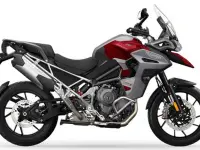
2026 Triumph Tiger 1200 GT Explorer
The 2026 Triumph Tiger 1200 GT Explorer is a versatile adventure tourer designed for riders seeking long-distance comfort and genuine off-road capability. Powered by a 1160cc triple-cylinder engine producing 147 horsepower and 130 Nm torque, it excels at blending spirited road performance with trail-ready handling. Best suited for adventurous touring enthusiasts, this middleweight adventure bike delivers balanced performance across diverse terrains and riding conditions.

2026 BMW R 1250 GS Adventure
The 2026 BMW R 1250 GS Adventure is a long-distance adventure bike with a 1,254cc boxer twin making 136 hp and 143 Nm, and shaft drive. It carries 29.9 litres of fuel, has a tall 890 mm seat and weighs 268 kg fuelled.
2026 Triumph Tiger 1200 GT Explorer vs 2026 BMW R 1250 GS Adventure: the key differences
Both are adventure bikes, so this is a like-for-like choice.
- The 2026 Triumph Tiger 1200 GT Explorer makes 11 hp more (147 vs 136 hp).
- The 2026 BMW R 1250 GS Adventure has 13 Nm more torque (130 vs 143 Nm).
- The 2026 Triumph Tiger 1200 GT Explorer is 12 kg lighter (256 vs 268 kg).
- The 2026 Triumph Tiger 1200 GT Explorer has a 40 mm lower seat (850 vs 890 mm), which helps shorter riders.
2026 Triumph Tiger 1200 GT Explorer: Built as a premium long-distance adventure tourer that prioritizes comfort, stability, and shaft-drive low maintenance over outright off-road capability.
2026 BMW R 1250 GS Adventure: Built for long-distance adventure touring: a 30-litre tank, shaft drive and boxer torque devour highways, backroads and light off-road trails fully loaded.
Verdict: Choose the 2026 Triumph Tiger 1200 GT Explorer if you want more power, lighter weight and a lower seat. Choose the 2026 BMW R 1250 GS Adventure if you want more torque. Check the full table below for every figure, and the size comparison for fit.
How they ride
Editorial estimate from the spec sheet - not lab tested. Further out = stronger on that axis.
| 2026 Triumph Tiger 1200 GT Explorer | 2026 BMW R 1250 GS Adventure | |
|---|---|---|
| Speed | 78 | 80 |
| Agility | 62 | 55 |
| Comfort | 92 | 92 |
| Off-road | 55 | 62 |
| Touring | 95 | 96 |
| Road manners | 85 | 88 |
| Specification | 2026 Triumph Tiger 1200 GT Explorer | 2026 BMW R 1250 GS Adventure |
|---|---|---|
| Other | ||
| Category | Adventure | Adventure |
| Color Options | Snowdonia White, Carnival Red, Sapphire Black | Black Storm Metallic/Black/Agate Gray, Ice Grey, Light White/Racing Blue Metallic/Racing Red, Gravity Blue Metallic |
| Fuel Tank Material | Metal | - |
| Comments | - | 3 Ride Modes (ECO, Rain and Road). Traction Control. Hill Start Control. |
| Fork tube size | - | 37 mm (1.5 inches) |
| Tire pressure front | - | 36 PSI (2.5 Bar or 250 kPa) |
| Tire pressure rear | - | 42 PSI (2.9 Bar or 290 kPa) |
| Engine | ||
| Capacity: | 1160.0 ccm (70.79 cubic inches) | 1254.0 ccm (76.52 cubic inches) |
| CO2 Emissions | 144 CO2 g/km | - |
| EPA Certificate No. | TTDXC1.16PMC-005-R01 | - |
| EPA Est. Fuel Consumption | 6.15 L/100km (38.2 US mpg) | - |
| EPA CO Emissions | 2.0 CO g/km | - |
| Engine Type | In-line three-cylinder, four-stroke | Boxer, four-stroke |
| Fuel Consumption | 4.90 litres/100 km (20.4 km/l or 48.00 mpg) | ✓4.80 litres/100 km (20.8 km/l or 49.00 mpg) |
| Bore x Stroke | 90.0 x 60.7 mm (3.5 x 2.4 inches) | 102.5 x 76.0 mm (4.0 x 3.0 inches) |
| Compression | 13.2:1 | 12.5:1 |
| Cooling System | Liquid | Liquid |
| Fuel System | Injection | Injection |
| Starting | Electric | Electric |
| Aspiration | Naturally aspirated | - |
| Valves Per Cylinder | 4 | 4 |
| Lubrication System | - | Dry sump |
| Performance | ||
| Power | ✓147.0 HP (110.4 kW) @ 9000 RPM | 136.0 HP (100.0 kW) @ 7750 RPM |
| Torque | 130.0 Nm (13.3 kgf-m or 95.9 ft.lbs) @ 7000 RPM | ✓143.0 Nm (14.6 kgf-m or 105.5 ft.lbs) @ 6500 RPM |
| Power/Weight Ratio | 0.5747 HP/kg (wet) | 0.5073 HP/kg (wet) |
| Top Speed | - | 193.1 km/h (120.0 mph) |
| Chassis & suspension | ||
| Frame | Tubular steel frame, with forged aluminium outriggers. Fabricated, bolt-on aluminium rear subframe. | Two-section frame, front- and bolted on rear frame, load-bearing engine |
| Front Suspension | Showa 49mm, semi-active damping USD forks | BMW Motorrad Telelever; stanchion diameter 37 mm, central spring strut |
| Rear Suspension | Showa semi-active damping monoshock, with automatic electronic preload adjustment | Cast aluminium single-sided swing arm with BMW Motorrad Paralever; WAD strut (travel-related damping), spring pre-load hydraulically adjustable (continuously variable) at handwheel, rebound damping adjustable at handwheel. |
| Front Wheel Travel | 200 mm (7.9 inches) | 210 mm (8.3 inches) |
| Rear Wheel Travel | 200 mm (7.9 inches) | 220 mm (8.7 inches) |
| Rake (fork angle) | 24.0° | 24.9° |
| Trail | 120 mm (4.7 inches) | 97 mm (3.8 inches) |
| Transmission | ||
| Gearbox | 6-speed | 6-speed |
| Transmission Type | Manual | Manual |
| Final Drive | Shaft | Shaft |
| Clutch | Hydraulic, wet, multi-plate, slip and assist | Wet clutch with an anti-hopping function, hydraulic activation |
| Brakes & wheels | ||
| Front Brakes | Double disc. Brembo M4.30 Stylema monoblock radial calipers, ABS. | Double disc. ABS. Floating discs. Four-piston calipers. |
| Front Brakes Diameter | 320 mm (12.6 inches) | 305 mm (12.0 inches) |
| Rear Brakes | Single disc. Brembo single piston caliper, ABS. | Single disc. ABS. Floating disc. Two-piston calipers. |
| ABS | Yes | Yes |
| Front Tyre | 120/70R19 (M/C 60V TL) | 120/70-R19 |
| Rear Tyre | 150/70R18 (M/C 70V TL) | 170/60-R17 |
| Dimensions & weight | ||
| Wheelbase | 1560 mm (61.4 inches) | 1504 mm (59.2 inches) |
| Overall Length | 2248 mm (88.5 inches) | 2207 mm (86.9 inches) |
| Overall Width | 849 mm (33.4 inches) | 953 mm (37.5 inches) |
| Overall Height | 1497 mm (58.9 inches) | 1430 mm (56.3 inches) |
| Seat Height | ✓850 mm (33.5 inches) | 890 mm (35.0 inches) |
| Wet Weight | ✓255.8 kg (563.9 pounds) | 268.1 kg (591.1 pounds) |
| Fuel Capacity | ✓30.00 litres (7.93 US gallons) | 29.90 litres (7.90 US gallons) |
| Reserve fuel capacity | - | 4.00 litres (1.06 US gallons) |
| Maintenance | ||
| Tyre pressure (solo) | Front 220 kPa (32 psi), rear 290 kPa (42 psi) | - |
| Engine oil | 10W-40 or 10W-50, API SN or higher, JASO MA2 | - |
| Oil capacity | 4.00 litres (4.23 US quarts) | 4.00 litres (4.23 US quarts) |
| Oil change | 3.65 litres (3.86 US quarts) | - |
| Oil change with filter | 3.85 litres (4.07 US quarts) | - |
| Fuel grade | Unleaded, 89 PON (AKI) or higher (95 RON minimum) | - |
| Battery | HJTZ14S-FPZ, 12 V 8 Ah | - |
| Spark plug | NGK LMAR9E | - |
| Coolant | Triumph D2053 OAT, premixed 50/50 | - |
| Coolant capacity | 3.00 litres (3.17 US quarts) | - |
| Maximum load | 222 kg (489 pounds) | - |
| Brake fluid | - | DOT 4 |
| Reliability & safety | ||
| Bike Reliability ⓘ | 98 / 100 (excellent) All years of this model |
✓99 / 100 (excellent) All years of this model |
| Passed roadworthiness test first time | 95.5% (516 tests) | 96.2% (7,146 tests) |
| Safety recalls | 0 | 0 |
"Best" (✓) reflects that single spec only, not overall suitability - a bike can win on paper and still be the wrong choice for you. Ties are all marked; specs with no clear better/worse direction (e.g. displacement, wheel size) are never marked, only tinted where bikes differ.
Affiliate links - we may earn a commission from qualifying eBay purchases made through these links.
About this comparison tool
This tool puts up to four motorcycles side by side across their full specification sheets, drawn from a database of 46,000+ models and 1.73M+ individual specifications. Wherever a spec has a clear "better" direction - more power, less weight - the strongest figure in that row is highlighted automatically.
How to use it
Pick a make, model and year for each bike; the model and year lists update to match what you've selected. Two bikes are enough - use "Add another bike" for a third or fourth. Comparisons work across model years too, so you can compare a bike against its own earlier generation. Once you're happy with the lineup, use "Copy share link" to send it to someone else.
What gets compared
Specs are pulled from the same categories used throughout the site: engine and transmission (capacity, power, torque, gearbox), physical measures (weight, seat height, fuel and tank capacity), frame and dimensions, speed and acceleration, and brakes, suspension, frame and wheels (including tyres) - plus general information and maintenance data where it's on record for a bike.
How the highlighting works, and its limits
A highlighted cell means one bike has the clearly better raw number for that spec - more power, less weight, and so on. Fields where "better" genuinely depends on the rider - seat height above all - are deliberately never highlighted: a lower seat isn't automatically the right choice, it's a fit question only you can answer. Winning a row also isn't the same as winning the comparison - a bike can lead on paper in half the rows and still be the wrong bike for you.
Frequently asked questions
Can I compare bikes from different categories, like a scooter against a superbike?
Yes - the tool doesn't restrict what you compare, though a highlighted spec means less when the two bikes aren't really doing the same job.
What happens if a spec is missing for one of the bikes?
It shows as "-" and is never highlighted as a winner - a missing figure never beats one that's actually reported, and never blocks the rest of the row.
Are older model years included?
Yes - each bike's year list covers every model year in the database, so you can compare this year's bike against an earlier generation of the same model.
How do I share a comparison?
Every comparison has its own stable URL - use "Copy share link", or just copy the address bar. The same bikes in the same order always produce the same link.