

2026 Kawasaki Z900 ABS vs 2026 Yamaha MT-09 — Spec Comparison
Choose up to 4 bikes to compare
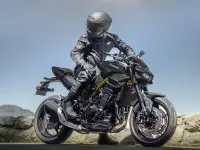
2026 Kawasaki Z900 ABS
The 2026 Kawasaki Z900 ABS is a middleweight naked bike that delivers sharp handling and aggressive styling for riders seeking accessible performance. Its 948cc parallel-twin engine produces strong midrange torque, while the lightweight chassis and composed suspension make it equally at home carving corners or commuting. Best known for combining modern features like ABS and fuel injection with classic Z lineage appeal.

2026 Yamaha MT-09
The 2026 Yamaha MT-09 is a middleweight naked bike powered by an aggressive 890cc triple-cylinder engine delivering 68.6 ft-lb of torque, designed for riders seeking spirited streetfighting performance and versatility. Known for its distinctive three-cylinder character, responsive handling, and accessible ergonomics, the MT-09 excels as both a daily commuter and weekend canyon carver. Its assist and slipper clutch technology enhances controllability during aggressive riding and engine braking scenarios.
Size comparison unavailable for the first two bikes - not enough geometry data (missing category and/or wheelbase/overall length) to draw an honest silhouette.
| Specification | 2026 Kawasaki Z900 ABS | 2026 Yamaha MT-09 |
|---|---|---|
| Engine and Transmission Specifications | ||
| Capacity | 948cc | 889 cc |
| Bore x Stroke | 73.4 x 56.0mm | 78.0mm x 62.1mm |
| Compression Ratio | 11.8:1 | 11.5:1 |
| Max Torque | 73.1 lb-ft @ 7,700 rpm | 93 Nm (68.6 ft-lb) @ 7,000 rpm |
| Induction | DFI® with 36mm throttle bodies | Fuel injection with YCC-T |
| Ignition | TCBI with Electronic Advance | TCI: Transistor Controlled Ignition |
| Gearbox | 6-speed, return shift | 6-speed; multiplate wet clutch; with Assist & Slipper clutch |
| Final Drive | Sealed chain | Chain |
| Max Power | 100 kW {136 PS} / 9,000 rpm | — |
| Lubrication System | Forced lubrication, wet sump | Wet sump |
| Clutch | Wet multi-disc, manual | — |
| Engine Type | — | 890cc liquid-cooled, DOHC, inline 3-cylinder; 4 valves per cylinder |
| Physical measures and capacities | ||
| Ground Clearance | 5.7 in | 140 mm (5.5´´) |
| Seat Height | 31.9 in | 32.5 in |
| Wet Weight | 469.7 lb* 50-State Model; 467.5 lb* 49-State Model | 425 lb |
| Fuel Capacity | 4.5 gal | 3.7 gal |
| Wheelbase | 57.1 in | 56.3 in |
| Overall Length | — | 2,090 mm (82.3´´) |
| Overall Width | — | 820 mm (32.3´´) |
| Overall Height | — | 1,145 mm (45.1´´) |
| Frame and dimensions | ||
| Front Tyre | 120/70-17 | — |
| Rear Tyre | 180/55-17 | — |
| Front Brakes | Dual 300mm semi-floating discs with radial-mount 4-piston calipers and ABS | — |
| Frame | Twin-tube, aluminum | — |
| Trail | 110 mm | 4.3 in |
"Best" (✓) reflects that single spec only, not overall suitability - a bike can win on paper and still be the wrong choice for you. Ties are all marked; specs with no clear better/worse direction (e.g. displacement, wheel size) are never marked, only tinted where bikes differ.
About this comparison tool
This tool puts up to four motorcycles side by side across their full specification sheets, drawn from a database of 37,000+ models and 1.25M+ individual specifications. Wherever a spec has a clear "better" direction - more power, less weight - the strongest figure in that row is highlighted automatically.
How to use it
Pick a make, model and year for each bike; the model and year lists update to match what you've selected. Two bikes are enough - use "Add another bike" for a third or fourth. Comparisons work across model years too, so you can compare a bike against its own earlier generation. Once you're happy with the lineup, use "Copy share link" to send it to someone else.
What gets compared
Specs are pulled from the same categories used throughout the site: engine and transmission (capacity, power, torque, gearbox), physical measures (weight, seat height, fuel and tank capacity), frame and dimensions, speed and acceleration, and brakes, suspension, frame and wheels (including tyres) - plus general information and maintenance data where it's on record for a bike.
How the highlighting works, and its limits
A highlighted cell means one bike has the clearly better raw number for that spec - more power, less weight, and so on. Fields where "better" genuinely depends on the rider - seat height above all - are deliberately never highlighted: a lower seat isn't automatically the right choice, it's a fit question only you can answer. Winning a row also isn't the same as winning the comparison - a bike can lead on paper in half the rows and still be the wrong bike for you.
Frequently asked questions
Can I compare bikes from different categories, like a scooter against a superbike?
Yes - the tool doesn't restrict what you compare, though a highlighted spec means less when the two bikes aren't really doing the same job.
What happens if a spec is missing for one of the bikes?
It shows as "—" and is never highlighted as a winner - a missing figure never beats one that's actually reported, and never blocks the rest of the row.
Are older model years included?
Yes - each bike's year list covers every model year in the database, so you can compare this year's bike against an earlier generation of the same model.
How do I share a comparison?
Every comparison has its own stable URL - use "Copy share link", or just copy the address bar. The same bikes in the same order always produce the same link.
Popular Comparisons
Sportbikes
Naked & Streetfighter
Adventure & Touring
Scooters & Commuters